
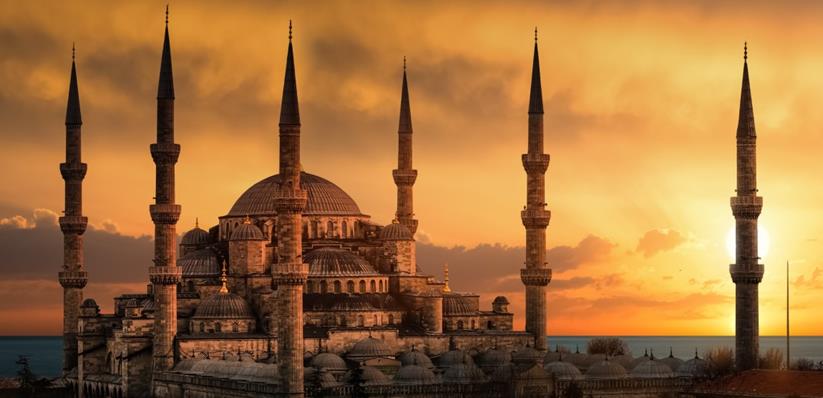
Istanbul! It was Constantinople and now it’s Istanbul. (That’s some old song that for whatever reason, is part of my vast compendium of useless information which makes me such a coveted trivia partner!)
Istanbul is an ancient, important, well-positioned and awe-inspiring city and has been for centuries. Once the capital of the Roman empire and known for a short time as Nova Roma (New Rome), Istanbul is a jewel. The architecture here is incredible! Most notably the Hagia Sofia, the impressive and stately mosque originally built as an Orthodox Christian church in 537 A.D. This massive and ornate structure was the largest church in the world for nearly 1000 years. This Byzantine beauty is known the world over for its incredible dome, and how that dome came to be is an interesting story. The dome was originally built without the architectural and engineering knowledge we have today and was destroyed twice before the idea of building the main dome on top of half domes with four pendentives, which distribute the weight to the walls below. 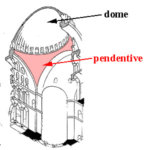 Here’s a sketch showing what the heck a pendentive is (and this is one more reason I love to travel – learning more crossword puzzle words!) Hereafter, domes around the world were built using this new technology learned from the Hagia Sofia (which means Holy Wisdom). #yourewelcome.
Originally built in only 5 years with the manpower of 11,000 workers (aka slaves) as a Christian church, it was taken over and turned into a mosque for Muslims in 1453 (Turkey is predominantly a Muslim country.) Many of the Christian mosaics and paintings were plastered over, thus preserving them for rediscovery in the renovations during the 1800s. The Hagia Sofia is no longer used as a place of worship, as it was turned into a museum for public use in the 1930s.
The soaring domes, glittering gold Islamic calligraphy, mosaics, artwork, and stencils are stunning. It is breathtaking. Simply incredible. I did not purchase the audio tour at the Sofia – I used an audio guide I found online, called izi.Travel by Cultrex, and clicked the appropriate sections of the tour as I needed them. It was comprehensive, interesting and free! Always a good idea to search for these free audio tours and download them to your phone before heading to a major attraction. Rick Steves offers many, but I didn’t find one for Istanbul.
In the northwest corner of the building, there is a column with a hole in the middle covered by bronze plates. Known both as the perspiring column and the wishing column, you’ll see a line of people in front of it, waiting their turn to make a wish. Back in the day, rumor had it that this divot in the column had a healing effect on humans.  The story goes like this: Emperor Justinian was wandering in the church with a severe headache and leaned his head against the cool stone column. Soon he realized that his headache was gone. The story got out among his people, and they believed that they would get better if they put their fingers into the hole in the column and then touch their fingers to the place where they felt pain. Here’s what you do: place your thumb in the opening, and if you can rotate your hand 360 degrees, make a wish and it will come true.
The other tale I’ve heard about this magical orifice is that once the church became a mosque, it should face toward Mecca as all good mosques do, which is southeast from Istanbul. However, the church was build facing east…what to do? The legend says that a mystical figure in Islamic mythology named Khidr arrived to turn the Hagia Sophia toward Mecca and stuck his thumb into this column to rotate the mosque, but he was seen by the people and had to quickly vanish…before he could turn the holy place toward Mecca. Which version do you prefer?
I visited the Basilica Cisterns and learned about this underground water reservoir which was built in the 6th century and supplied water to the Justinian palace and the buildings nearby. Inside the cistern are 336 columns, each of which is 30 feet (9 m) high and set in twelve rows of 28 columns each. Beautiful, stately and grand. Roughly the size of two football fields, the cistern contained nearly 100,000 tons of water in its heyday – that’s nearly 27 MILLION gallons!! It fell into disrepair and disuse and was rediscovered in 1545. It’s now undergoing a massive renovation and there’s presently no water in the cistern as of November 2018, but it’s still worth seeing.


But the most intriguing part of the Cisterns for me was the Medusa heads. Two large heads supported two columns in one corner of the cistern. As Greek mythology has it, the snake-haired Medusa, one of the three Gorgon sisters, had the power of turning anyone that happened to look at her into stone forever, and paintings and sculptures were placed in important structures and venues for protection. Hence, the Medusa heads in the cistern – but oddly enough, they were placed upside-down. Even the Smithsonian is unsure of why they were upside down (actually, one is upside-down, the other placed sideways) but one theory points to the early Christian practice of putting pagan statues upside-down to make a bold statement about their faith. Either way, it’s photographic and a mesmerizing site.
Another mosque I was privileged to visit was the Süleymaniye, located along the sea overlooking the Asian section of Istanbul. Yes! Did you know that Istanbul is located on two continents!? There’s the European side and across the Bosphorus Straits, the Asian side; one of only 4 cities in the world that spans two continents. Built in the 1500s for Süleymaniye the Magnificent one thousand years after the Hagia Sofia and utilizing the building techniques learned from that mosque, this mosque contains four minarets soaring to the heavens, a plethora of balconies, twenty-four domes, a fountain and an enormous court outside paved in enormous white slabs of marble (from Carrara, Italy perhaps??) Fun fact: ostrich eggs are placed in the gorgeous and glittering suspended chandeliers in the mosques, between the lights. They are thought to prevent spiders from spinning webs on the light fixtures by emitting a smell that only spiders can detect…
A visit to Istanbul would not be complete without seeing the Blue Mosque. When I first arrived in Istanbul, I looked around the main square, puzzled…I couldn’t find the Blue Mosque. There was the Hagia Sofia, and across from the plaza sat another ginormous mosque, but nothing that looked blue. Well, I learned that the “blue” reference is because of the fifty thousand brilliant blue tiles depicting more than 50 different tulip designs which line the interior of the mosque.
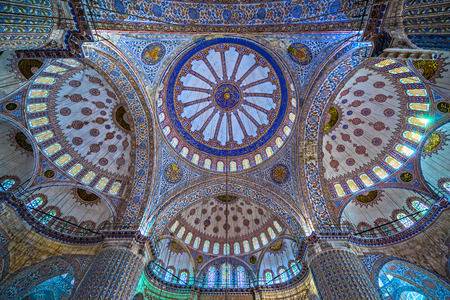
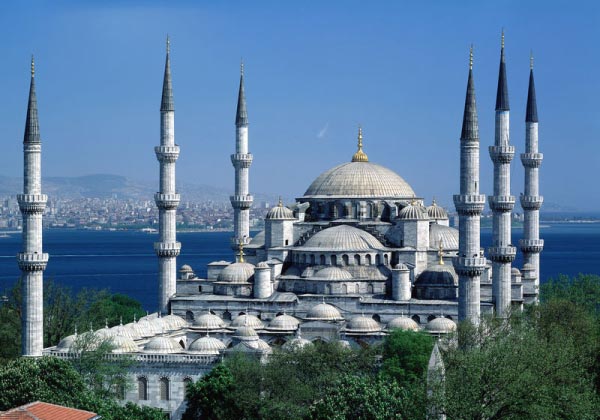
The Sultan Ahmed Mosque, also known as the Blue Mosque, has one main dome, six minarets, and eight secondary domes and was built in 1616 – over 1000 years AFTER the Hagia Sofia.
Light filters into the mosque through the 200 stained glass windows, emitting a soft warm glow which is enhanced by the ornate chandeliers suspended from above. You’ll see the ostrich eggs on the chandeliers, just like in the Süleymaniye! But unlike the Hagia Sofia which is now a museum, the Blue Mosque is an active house of worship, with the prayerful still attending, first performing ablutions (washing their hands and feet)
 before devoutly kneeling in orderly rows on stripes of the the plush carpet and placing their forehead to the floor to send their prayers heavenward as the mystical call to prayer echoes across the land, floating out over the city five times a day. (Note: the mosque is closed to visitors during worship times, so check the signage at the entrance. )
Interesting fact: A heavy iron chain hangs in the upper part of the court entrance on the western side. Only the sultan was allowed to enter the court of the mosque on horseback. The chain was put there so that the sultan had to lower his head every time he entered the court to avoid being cracked on the head. This was a symbolic gesture, to ensure the humility of the ruler in the face of the divine.

The history. The architecture. The people. The tales. The food. The vibe. These are all the reasons I’d visit Istanbul again and again.
Your time is limited, so don’t waste it living someone else’s life. Don’t be trapped by dogma, which is living with the results of other people’s thinking. Don’t let the noise of other’s opinions drown out your own inner voice. And most important, have the courage to follow your heart and your intuition. ~ Steve Jobs
Discover more from Posts from a Flashpacker
Subscribe to get the latest posts sent to your email.


1 comment
Love your travelogues, I feel like I’ve been on the road with you!!